

Is your Shopify store growing… but your operations are starting to feel stretched?
More orders should mean more momentum. Instead, you might find yourself spending more time on logistics than on building your brand. What began as manageable in-house fulfilment can quickly turn into late packing sessions, courier cut-off pressure and constant stock checks.
If growth feels heavier than it should, outsourcing Shopify fulfilment to a third-party logistics partner could take the pressure off and help
Signs Your eCommerce Fulfilment Setup Is Holding You Back
At the start, in-house fulfilment feels efficient. You know where everything is. You can handle fulfilment yourself. Costs feel controlled. But as order volume increases, what once felt lean can start to feel limiting.
Here are the signs your current setup is starting to hold your eCommerce business back:
- You’ve got stock in one place and are packing somewhere else. Orders wait, shipments get delayed, and delivery times stretch.
- You’ve got stockouts, where your eCommerce platform shows one thing, and your shelves say another. Visibility drops and customer satisfaction follows.
- If someone is still manually exporting orders or copying tracking numbers, your order management is working harder than it should.
- You have limited shipping options, rising shipping rates and no flexibility when volumes spike.
- Peak seasons and promotions show up operational cracks. What works in quiet months struggles when order volume increases.
The Shopify Order Fulfilment Process When Partnered with a 3PL
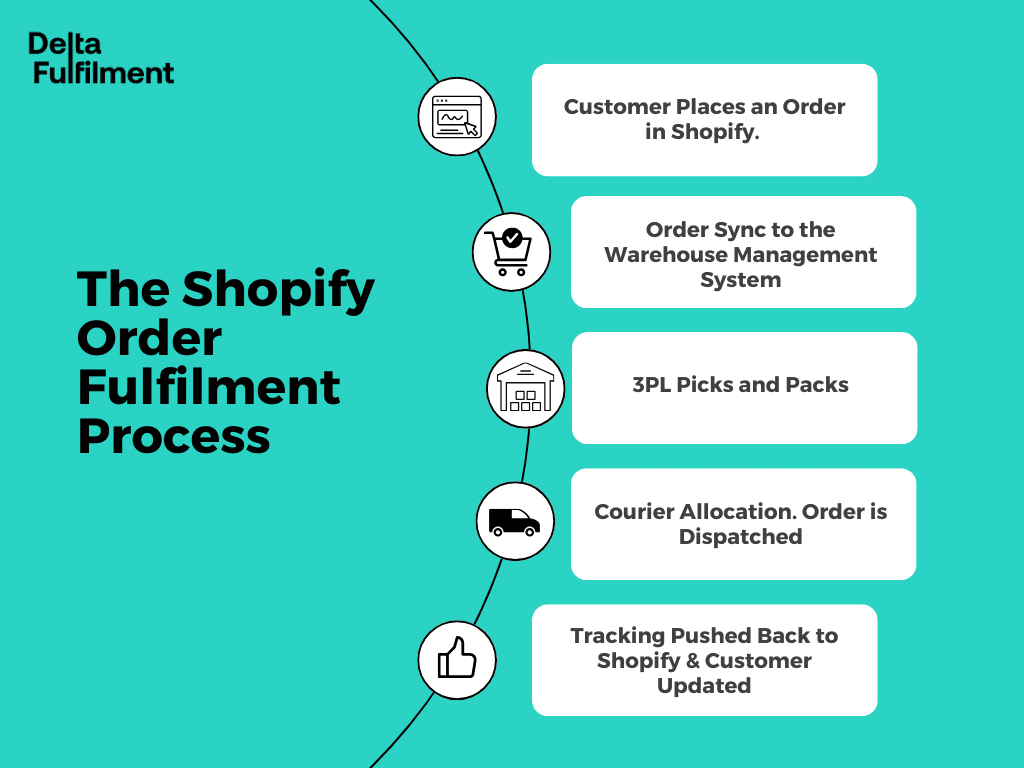
1. Order Placed in Shopify
A customer places an order through your online store. Payment is confirmed, and the order details are captured inside your eCommerce platform.
2. Order Sync to the Warehouse Management System
The order flows automatically into the warehouse management system. There’s no manual forwarding or exporting. Your order management system updates in real time.
3. Picking & Packing
The fulfilment centre team receives an order and picks items using barcode scanning to protect order accuracy. Products are packed in line with your brand guidelines and are ready for dispatch.
4. Courier Allocation
Based on shipping rules, the destination, and the selected delivery option, the system assigns the most suitable courier from the wider fulfilment network. Shipping rates and service levels are applied automatically.
5. Tracking Pushed Back to Shopify
Once the shipment leaves the fulfilment centre, tracking information syncs back into Shopify. Your customer receives confirmation and can monitor delivery times without extra admin from your team.
Returns Flow
If an item comes back, it’s processed through the same warehouse management system. Stock is checked, updated and made visible again inside your eCommerce platform.
How the Transition to Outsourced Fulfilment Works
1. Choose the Right 3PL
Look for a fulfilment provider with proven experience supporting Shopify brands and wider eCommerce brands. They should understand how your eCommerce platform connects to their warehouse management system, offer clear SLAs, and have capacity across their fulfilment network to scale as your order volume increases.
2. Clean Up Your SKU Data
Clear product information makes warehouse management far easier. Check your SKUs are consistent, weights and dimensions are accurate, and product titles match what’s listed in your eCommerce platform. Good data supports smooth order processing and accurate shipping rates, especially once order volume increases.
If you sell bundles or kits, make sure that the details are up to date. This helps the warehouse management system recognise what should be picked together.
3. Confirm Packaging & Branding Rules
Think about how you want your orders to arrive, including branded inserts, sustainable packaging and specific labelling requirements. A clear brief helps your fulfilment provider set up packing and shipping processes that properly reflect your brand.
If you’re planning subscription boxes or promotional campaigns, outline those early, too.
4. Connect Your Shopify Store
Your Shopify store integrates directly with the 3PL’s warehouse management system via an API.
Orders, stock levels and tracking updates sync automatically. Shipping logic, courier rules and free shipping thresholds are configured within the system. Test orders are run to confirm everything flows correctly before going live.
This stage makes sure your order management runs cleanly once real orders start moving through the fulfilment centre.
5. Send Stock to the Warehouse
Stock is delivered into the fulfilment centre and booked in through a structured goods-in process.
Each SKU is scanned, mapped and stored in the warehouse. Inventory is aligned with your Shopify store so that when the system receives an order, it knows exactly where stock sits and how it should be picked.
6. Go Live
Once integration is tested and stock is in place, you agree on a date for going live.
Orders begin flowing directly from your Shopify store into the fulfilment centre. The warehouse management system receives an order, allocates it for picking, and prepares it for shipment.
From that point, fulfilment is running through your new third-party logistics setup, giving you the structure and capacity to support your next phase of growth.

Scaling a subscription model on Shopify?
Recurring orders change how logistics work. Fixed dispatch dates, bundled products and forecasted stock all need structure behind them. We’ve covered it in our guide to Shopify order fulfilment for subscription brands.
Benefits of Outsourcing Shopify Fulfilment Operations
As your Shopify business grows, your logistics need to grow with it. Bringing in a specialist third-party logistics partner gives your eCommerce operation the structure and capacity to properly support that growth.
Real-Time Shopify Integration
A 3PL provider connects directly to your eCommerce platform through a warehouse management system.
When a customer places an order on your Shopify store, it flows straight into the fulfilment centre. Order processing becomes automatic, tracking updates feed back into Shopify, and your order management system runs without manual intervention.
You gain clear visibility over stock, orders and shipment status across your sales channels, helping streamline daily operations and protect order accuracy as order volume increases.
Centralised Inventory Management
Stock is held in a single, organised fulfilment centre with defined warehouse management processes.
Inventory levels sync in real time with your Shopify store, supporting accurate forecasting and smoother eCommerce fulfilment. As order volume increases, your stock data stays aligned with what’s physically on the shelf.
For many Shopify merchants, this is where logistics start to feel structured and predictable.
Scalable Pick & Pack
A dedicated fulfilment service uses barcode scanning, defined picking methods and quality control checks to handle packing and shipping consistently.
As your Shopify store grows, your fulfilment capacity grows with it. You pay for what you use, rather than investing in permanent warehouse space or expanding in-house fulfilment too early. That flexibility allows your eCommerce brands to scale without operational strain.
Multi-Courier Logistics at Volume Rates
Working with an established fulfilment network gives access to negotiated shipping rates and broader shipping options.
You can support competitive free shipping strategies, varied delivery times and reliable international shipment routes. This flexibility helps protect margins while maintaining strong customer expectations and customer satisfaction.
Returns Managed Properly
Returns are processed within the same warehouse management system used to receive and dispatch orders.
Items are checked, restocked and updated quickly, maintaining inventory visibility and keeping your eCommerce business moving smoothly.
When fulfilment is running with the right structure, you can focus on growing your business instead of managing day-to-day logistics.
Outsource Shopify Fulfilment with Delta Fulfilment
At Delta Fulfilment, we help Shopify brands grow to the next level with structured, measurable performance.
We process over 1 million orders per year, with 99.85% pick and pack accuracy and 99.92% of orders shipped within SLA. That level of consistency protects customer satisfaction as your order volume increases and keeps your eCommerce fulfilment predictable.
Through our established carrier relationships and wider fulfilment network, we secure competitive shipping rates and flexible shipping options that support stable delivery times across the UK and internationally.
Get a quote today and let’s explore how outsourcing your fulfilment can support your next phase of growth.