

Have you noticed customers not completing their purchases on your eCommerce site? Your shipping options could be to blame. It’s estimated that 46% of UK customers get frustrated with expensive shipping options at the checkout stage and abandon their cart.
Pricing your shipping fairly will improve your customer experience, increase the number of completed orders, and boost your bottom line. So, how do you get your eCommerce fulfilment right? Looking closely at your shipping costs data will help you choose the best shipping options for your business and help you stand out in a marketplace where every penny counts.
What is the Total Shipping Cost?
When we talk about the total shipping cost, we look at the complete picture of what you’ll pay to get your entire shipment from point A to point B.
Your total shipping cost includes:
- Base carrier rates (standard shipping charges from the carrier)
- Handling fees (costs for processing and preparing your order)
- Packaging materials
- Shipping insurance
- Fuel surcharges (extra fees for fluctuating fuel costs)
- Delivery confirmation
- Any special handling requirements
This figure is important when you are setting product prices, deciding on shipping policies, or looking for ways to trim expenses without compromising on service quality.
For example, if you’re considering offering free shipping to boost sales, you’ll need to know exactly how much it costs to send a package first! After all, there’s no point in making more sales if each one leaves your bank account lighter than before.
What is the Shipping Cost Per Unit?
Shipping cost per unit is the amount you pay to ship a single item from your warehouse to your customer’s doorstep. This value helps you understand how much each individual product costs to deliver, which becomes important when you’re setting prices.
Cost of Shipping Calculation and Formula
Total Shipping Cost Formula

Total Shipping Cost = Base Shipping Rate + Weight Charges + Distance Fees + Handling Costs + Insurance + Packaging Materials + Fuel Surcharges + Any Additional Fees
How It Works
You’ll need to add up all your costs to find your total shipping cost.
Shipping Cost Per Unit Formula

Shipping Cost Per Unit = Total Shipping Cost / Number of Units
How It Works
Once you have the total shipping cost for one shipment, you need to divide it by the number of individual items in that container or pallet.
For Example
If you’re shipping 100 t-shirts to a customer, and the total shipping cost is £200, then the calculation is: £200 / 100 = £2 per t-shirt.
This basic calculation works well for uniform shipments where all items are similar in weight and dimensions. However, most businesses ship various products, requiring a different approach.
More Advanced Methods to Estimate Shipping Costs
Using Dimensional Weight
Dimensional weight (or volumetric weight) is how carriers charge for the space your package takes up rather than just how heavy it is.

Dimensional Weight (kg) = (Length x Width x Height in cm) / 5000
How It Works
Carriers work out dimensional weight by multiplying your package’s length, width, and height in centimetres, and then dividing by a specific number (typically 5,000 for metric measurements).
When pricing up a shipment, carriers look at two things: the actual weight on a scale AND the space your package takes up in their vehicles. They will often charge for whichever is higher.
For Example
Your package weighs 3kg on the scale – that’s the actual weight. But when the carrier calculates the dimensional weight using that formula (length × width × height ÷ 5,000), they get 4.8kg. In this case, 4.8kg is higher than 3kg, so you’ll pay for that.
When you’re shipping something light but bulky (like a lampshade or a bundle of pillows), it doesn’t weigh much, but it takes up a lot of space in the delivery van. That space could have been used for other packages, so the carrier charges you for the space your package occupies.
For Mixed Shipments
A mixed shipment contains different products with varying weights, sizes, and values all going to the same destination. You need to distribute the shipping cost across your products fairly, and there are three common ways to do this:
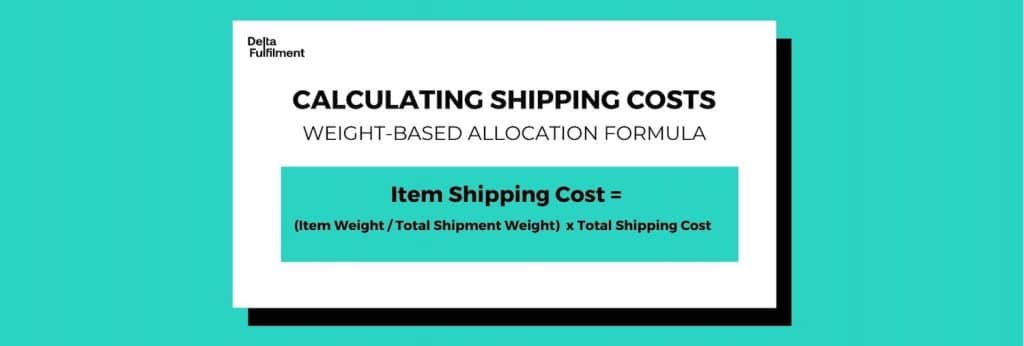
Weight-Based Allocation
Item Shipping Cost = (Item Weight / Total Shipment Weight) x Total Shipping Cost
How It Works
This method distributes shipping costs according to how much each item contributes to the total weight of the package. This is best for shipments where the weight is the main influence on the cost.
Using weight-based allocation is a fair way for businesses selling heavy items like books, homeware, or food products to determine their shipping pricing.
For Example
Imagine you’re shipping three products:
- A book weighing 0.5kg
- A T-shirt weighing 0.2kg
- A pair of trainers weighing 0.8kg
The total shipment weighs 1.5kg and costs £15 to ship.
- For the book: (0.5kg ÷ 1.5kg) × £15 = £5
- For the t-shirt: (0.2kg ÷ 1.5kg) × £15 = £2
- For the trainers: (0.8kg ÷ 1.5kg) × £15 = £8
Value-Based Allocation

Item Shipping Cost = (Item Value/Total Shipment Value) x Total Shipping Cost
How It Works
This approach assigns shipping costs based on each item’s price.
It’s perfect for when you’re shipping items with vastly different values but similar weights, such as luxury retail, jewellery, or electronics, where value far outweighs size. This means that the higher-priced items will absorb more shipping expenses like shipping insurance costs, and helps maintain profit margins on lower-priced items.
For Example
Let’s say you’re shipping:
- A necklace worth £80
- A bracelet worth £40
- A pair of earrings worth £30
The total value is £150, and shipping costs £15.
- For the necklace: (£80 ÷ £150) × £15 = £8
- For the bracelet: (£40 ÷ £150) × £15 = £4
- For the earrings: (£30 ÷ £150) × £15 = £3
Volume-Based Allocation

Item Shipping Cost = (Item Volume / Total Shipment Value) x Total Shipping Cost
How It Works
Volume-based allocation distributes costs according to how much space each item occupies in the package.
You should use this approach if you ship bulky but lightweight items or products that vary significantly in size but not in weight, like home décor, furniture, or sporting equipment.
For Example
You’re shipping a mixed load of:
- A lampshade with a volume of 0.03m³
- A small box of accessories with a volume of 0.01m³
- A decorative cushion with a volume of 0.02m³
The total volume is 0.06m³, and shipping costs £24.
- For the lampshade: (0.03m³ ÷ 0.06m³) × £24 = £12
- For the accessory box: (0.01m³ ÷ 0.06m³) × £24 = £4
- For the cushion: (0.02m³ ÷ 0.06m³) × £24 = £8
Hybrid Approaches
The best approach is often to combine methods to get the cheapest prices. Your shipping strategy can use specific methods based on the product category (e.g. weight-based allocations for mixed clothing deliveries and value-based for jewellery).
What affects shipping costs?
No one wants to receive an unexpectedly large shipping bill, so make sure you’re looking at all the factors that can push the costs up to see where you can make savings.
Weight & Dimensions
This is the most obvious reason shipping gets expensive: the heavier and bulkier your package, the more you’ll pay. A few grams might push you into the next weight bracket, or those extra centimetres on an extra large box could trigger dimensional weight charges.
Shipping Speed
Express shipping can cost 2-3 times more than standard delivery, so it’s worth finding a balance between cost and shipping times.
Destination & Zones
Shipping from one end of the country to the other will cost more than delivering to the next town. Carriers divide regions into shipping zones, with costs increasing as the distance grows.
For UK businesses, being aware of these zones can help you make strategic choices about where to focus your marketing efforts. If most of your customers are in a particular region, you might even consider positioning your warehouse there to minimise shipping costs.
Packaging Costs
When calculating your true shipping costs, don’t forget to include:
- Boxes, mailers, and envelopes
- Protective materials like bubble wrap and air pillows
- Tape and adhesives
- Labels and printing costs
- Branded packaging elements
Take a look at how you are packaging your products. If you see massive boxes filled with lots of bubble wrap, it’s a red flag. Not only is it environmentally questionable, but it’s also costing you a fortune in unnecessary shipping fees! Many businesses find using sustainable fulfilment best practices like standardising packaging sizes helps control these costs while still protecting products during transit.
Extra Costs in International Shipping
International shipping costs vary based on where you’re sending your parcels, how quickly they need to arrive, and which shipping method and carrier you choose. On top of these costs you need to factor in customs duties, taxes, and additional handling fees.
Check multiple carriers, understand the full scope of potential charges, and consider using fulfilment partners with established international shipping networks. Their bulk discounts and expertise can sometimes transform an unprofitable international market into a lucrative opportunity.
How to Reduce Shipping Costs
Ready to trim those shipping expenses without compromising service quality?
Shop Around For a Shipping Company
Different carriers have different strengths and pricing structures, so what works for one product line might not be ideal for another. You’ll want to weigh up DPD vs Royal Mail, as well as other carriers like DHL or Evri. And don’t forget about regional specialists who might offer competitive rates for specific areas.
Most carriers are also willing to negotiate, especially if you can commit to a certain volume of shipments. And if they don’t suit you now, remember to check back in with them regularly, as they often update their pricing and offers.
Create a Shipping Strategy
For each product category, weigh up flat-rate shipping vs. standard shipping. For standard shipping, split your regular shipments based on factors like their weight and size, delivery urgency, destination and value. Then, plan which carriers are most cost-effective for each category.
Try Zone Skipping
Rather than shipping each package individually from your warehouse to its final destination, you can consolidate your shipments through zone skipping. This is where multiple packages going to the same region are transported in bulk to a distribution centre in that area, and then a local carrier handles the final delivery.
The savings come from bypassing several shipping zones on individual packages. Instead of paying premium rates for each package to travel across multiple zones, you’re paying bulk freight rates to move your consolidated shipment, then local rates for the final leg.
Partner with Fulfilment Services
The beauty of working with fulfilment experts is that you tap into their economies of scale. Their shipping rates are typically lower than what you could negotiate independently, and their multi-location networks can dramatically reduce the distance your products travel to reach customers.
Take Control of Your Shipping Costs with Delta Fulfilment
At Delta Fulfilment, we know how tough shipping can be for growing eCommerce businesses. That’s why we use a variety of carriers with carefully negotiated rates, smart packaging, and efficient distribution networks to keep your shipping costs low and make sure your customers get their orders on time.
Whether you’re shipping across the UK, within Europe, or globally, our team can help you develop a shipping strategy that protects your margins while meeting your customers’ expectations. Contact us for a quote to learn more.