

Have you heard of the metric Cost of Goods Sold (COGS)? It might sound technical, but it’s just about knowing how much it costs to sell your products. But here’s the thing: getting it right can be the difference between profit and loss. No matter your eCommerce niche, from subscription boxes to pet supplies or fashion to electronics, getting familiar with your COGS will help you keep more profit in your pocket.
What is Cost of Goods Sold (COGS)?
In simple terms, the cost of goods sold calculation is the total direct cost of all products you’ve sold to customers over a specific time frame.
For most eCommerce businesses, calculating cost of goods sold includes:
- The purchase or production costs
- Raw materials and direct labour costs
- Shipping and handling costs from your supplier
- Storage costs before sale
Depending on the type of products you are selling, sector-specific indirect costs will also come into play. For example, fashion retailers need to factor in wholesale clothing costs, tags, and protective packaging, whereas food brands must account for specialist packaging and any special handling requirements like refrigeration.
Cost of Goods Sold Formula and Calculations
Basic COGS Formula
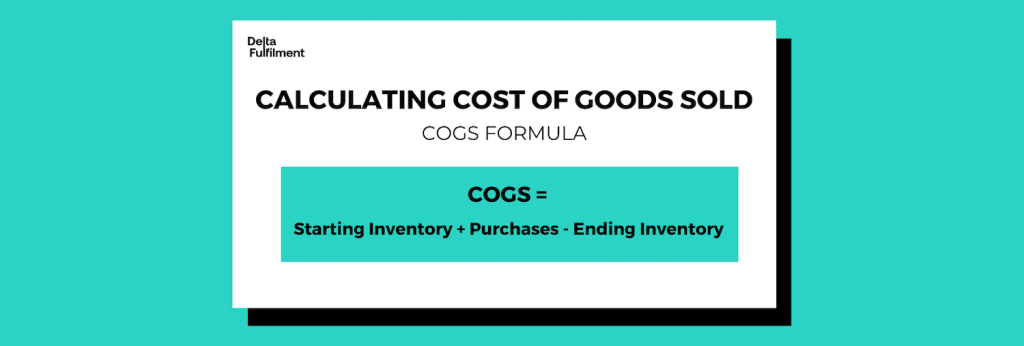
Starting Inventory + Purchases – Ending Inventory = COGS
Starting Inventory: This is the value of your stock at the beginning of your accounting period. For example, if you’re calculating January’s COGS, this would be your inventory value on January 1st.
Purchases: This includes all the inventory you’ve bought during your accounting period, plus any costs directly related to getting those products ready for sale. If you’re selling homewares, this might include both the products and their protective packaging.
Ending Inventory: This is what’s left in your warehouse at the end of your accounting period. For January, this would be your stock value on 31 January.
Example of How to Figure out the Cost of Goods Sold
Imagine you are an electronics retailer. Your starting inventory for January was £10,000, you made £5,000 in purchases during January, and your ending inventory was £8,000 on 31 January.
COGS = £10,000 + £5,000 – £8,000 = £7,000
This would mean you’ve sold £7,000 worth of inventory during this period.
Using COGS to Work Out Gross Profit and Gross Margins

The real insight comes from using COGs to calculate your eCommerce profit margins. By subtracting COGS from your revenue, you get gross profit. Then, divide that by revenue to get gross margin (%), which tells you how much of each sale remains after covering product costs.
Gross margin is an important profitability metric for working out your business’s sustainability and scalability.
Different Accounting Methods to Calculate Cost of Goods Sold
Calculating the cost of goods can be done in various ways, and you should choose the approach that suits your specific business needs.
FIFO Method (First In, First Out)
FIFO assumes that your oldest inventory (first in) is sold first. This method often makes the most sense for eCommerce businesses selling products with expiry dates, like food or beauty items.
How it works: If you bought 100 dog treats at £5 each in January, then 100 more at £6 each in February, FIFO assumes the £5 treats sell first. Your COGS starts with the January stock before moving to the February purchases.
LIFO Method (Last In, First Out)
LIFO assumes your newest inventory (last in) sells first. While less common in eCommerce, some businesses prefer this method for tax purposes because it matches higher recent costs against current sales, reducing taxable income when prices are rising.
How it works: Using the same pet treats example, LIFO would assume the £6 treats from February sell before the £5 treats from January.
Average Cost Method
This method accurately calculates COGS using the average cost of your inventory. It’s particularly useful for businesses selling similar items at different cost prices, like fashion retailers or subscription box services.
How it works: If you have 100 units at £5 and 100 units at £6, your average cost would be £5.50 per unit. This becomes your COGS calculation base.
Special Identification Method
This method tracks the actual cost of each specific item sold. It’s ideal for businesses selling unique or high-value items, like electronics or limited edition products.
How it works: Each product is individually tracked from purchase to sale, with its exact cost recorded. This gives you the most accurate COGS but requires detailed inventory management.
What can the Cost of Goods Sold tell you?
COGS will give you insights into:
Your Pricing Strategy
Knowing your COGS helps you tread the fine line of competitively pricing your products so they still make a healthy profit. You should compare your COGS to the selling price to figure out each unit’s profitability. If the COGS rises and your prices stay the same, your margins shrink, and you can rapidly veer into barely breaking even.
When you’re selecting new product lines, you can use COGS to work out how viable an item is too. For example, if you’re running a subscription box business, COGS will determine if that luxury item you’re eyeing up will work in your next box or whether the profit margin is too small.
Your Inventory
COGS shows which products are your real money-makers, and you might be surprised to find that they’re not the high-priced items. Selling pet supplies? Your premium cat food might have a lower COGS than those fancy toys, making it more profitable despite the lower price tag.
Your Business Health
By tracking COGS over time, you’ll spot trends before they become problems. Notice your costs creeping up? That’s your cue to chat with suppliers about better rates or explore new sourcing options.
If you’re selling on multiple platforms, like Amazon, Shopify, or TikTok Shop, tracking COGS per site is useful because each platform has its own fees. This helps you see where your products sell best and where the fees are more favourable.
Your Marketing Tactics
You should compare your COGS to your Customer Acquisition Cost (CAC). If the cost of finding a new customer is too close to the selling price, it’s time to boost your efforts to retain your current buyers and look at your pricing strategy.
Every CEO is interested in how their business is performing against their competitors. Whilst getting hold of competitor COGs is unlikely, you can apply your COGS to their pricing to get a guesstimate of how they are doing. This will give you an idea of how your pricing strategy compares and if you need to make adjustments.
Your Growth Potential
Planning to expand? Your COGS will tell you if you’ve got the margins to support growth. Whether you’re thinking about new product lines or expanding to new marketplaces, these numbers are your guide to making sound decisions.
What things are not included in the COGS formula?
COGS only includes costs directly related to acquiring and preparing your products for sale. Everything else falls under operating expenses, even if they’re essential for running your business.
Here’s what you shouldn’t include in your COGS:
Operating Expenses
- Marketing and advertising costs (yes, even those fancy Instagram ads)
- Rent for your office or warehouse
- Administrative staff salaries
- Utilities and internet costs
- General office supplies
- Professional services (like accountants or lawyers)
Cost of Sales
- Platform fees from Amazon, eBay, or Shopify
- Payment processing fees
- Customer service team costs
- Returns processing (though the value of returned inventory does affect COGS)
Distribution Expenses
- Shipping costs to customers
- Packaging materials for customer orders
- Last-mile delivery fees
Overhead Costs
- Insurance
- Business licenses
- Equipment maintenance
- Software subscriptions
What is a good cost of goods sold rate?
As soon as you have calculated your cost of goods, your first thought is likely to be, ‘How healthy is the business?’ or ‘What COGS rate should I be aiming for?’.
Unfortunately, there’s no golden standard for success, as a good COGS rate varies across different eCommerce sectors. Instead, it’s more important to understand how COGS impacts your profitability and gauge your rate against your industry peers.
What can influence your cost of goods sold rate?
Your COGS isn’t set in stone, as countless moving parts influence it in your eCommerce business. From your relationships with suppliers to the efficiency of your operations, each element determines your final costs.
COGS is like a puzzle where supplier relationships, market conditions, production efficiency, business scale, and industry-specific factors all need to fit together perfectly. Each piece requires regular attention and optimisation, such as negotiating better supplier rates, adapting to market changes, or streamlining operations.
How to Improve Your Cost of Goods Sold Rate
Supplier Strategy
Your supplier relationships can seriously impact your COGS. Building good partnerships and keeping an eye on terms can save you money while having multiple suppliers gives you more security and bargaining power.
Questions to consider:
- Do you get bulk purchase discounts?
- Have you negotiated early payment terms?
- When did you last compare supplier prices?
- Could you benefit from local suppliers to reduce shipping costs?
- Are your minimum order quantities optimised?
- Do you have backup suppliers for key products?
Inventory Management
Smart inventory management can really impact your COGS, so make sure you calculate your stock turnover rate too. If products are slow to sell, they tie up your money and eat into your profits.
This is especially true if you use FBA (Fulfilment by Amazon) because Amazon charges extra fees for long-term storage. If products sit too long in their warehouses, those costs can quickly add up, hurting your bottom line. In some cases, it’s worth reviewing your Amazon fulfilment strategy and considering Amazon FBA vs FBM (Fulfilment by Merchant) to see which option makes more financial sense for slow-moving inventory.
Things to check:
- What’s your current stock turnover rate?
- Have you identified your fastest and slowest-moving products?
- Are your reorder points optimised?
- How do you track seasonal demand?
- Is your warehouse layout efficient?
- Could automation reduce handling costs?
Product Portfolio
What you sell shapes what you spend. Regularly reviewing your product range helps you spot which items make good money and where you might need to make changes.
Details to explore:
- Do you know your highest and lowest-margin products?
- How well do your bestsellers perform after costs?
- Could you cut down your product range?
- Are there similar products you could add?
- Are your products priced right for the market?
- Have you thought of creating your own branded products?
Operational Efficiency
Little mistakes in how you run things can cost you big money over time. Take a good look at your operations and fix what isn’t working to keep your costs down. Switching to automated fulfilment can really help reduce human errors and improve efficiency.
Areas to look at:
- How long does it take to process each order?
- Could your packaging be more cost-effective?
- Are there bottlenecks in your fulfilment process?
- Have you considered automation tools?
- Is your storage space being maximised?
- Are you tracking wastage and damages?
Partner with Delta Fulfilment to Improve Your COGS
Worried about your COGS eating into your profits? Improving your inventory management is a surefire way to get better margins. By keeping your stock levels right and your storage costs down, you can seriously trim those expenses without compromising on quality or service.
We have a variety of eCommerce platform integrations, so we can manage your inventory across Amazon, Shopify, or eBay with real-time tracking and automated reordering to prevent costly stockouts. With our flexible storage solutions and expert team handling the day-to-day, you can focus on managing your business while we keep your COGS in check.
Want to see how much you could save? Contact us for a quote to learn more.